I’m back! This time I have called myself «Fat Pinarello Rider» because it’s a stereotype that I never thought I would end up becoming. Perhaps I’ll do a quick video about that, yes.
I have had a long break from cycling due to a serious injury (total foot reconstruction). Perhaps I’ll do a video about that too, definitely.
I plan to make some more videos, I’m not sure how many. I’d also like to do a video about why I quit the www.Tenerife-Training.net cycling business for instance.
My intention is to make completly honest reviews (with no script).
Reason being, I don’t really like a lot of the fake videos that you see on some of the more successful YouTube channels. Yes they are well-edited and «professional» and filmed on location and everything, but they seem to me to be very staged and they are almost awkward to watch. I prefer to come across like I am in the same room as you simply talking about cycling. I would call it a «warts and all» approach.
I would also like to reveal what I personally like and also what I don’t like. I’ve noticed that YouTube videos with paid content are almost never critical of anything and I don’t like that.
I’d also like to document or capture my training progress, some of the hurdles I have faced recently and how I am overcoming them. I think this makes for interesting viewing.
The more views and subscribers I get, the more videos I’ll make it’s as simple as that really.
I already have #2 and #3 google rankings for the search term «Fat Pinarello Rider» (it was actually #1 a few days ago)… or maybe that was for the search term «FatPinarelloRider«. Hmm.
That’s something to be proud of I think.
That’s my update for today anyway. I hope you can join me.
When I was working at Tenerife-Training.net delivering rental bikes, I saw a lot of things. One of the not so nice aspects of running that business were the accidents…
No one ever ‘plans’ on having an accident. That’s why they’re called ‘accidents’. Because they’re totally unexpected. Accidents happen when you least expect it. That’s the very definition of an accident I think.
One time a dog ran across the road and a cyclist tried to swerve around it and consequently broke his leg. Another time a man skidded off the road into some bushes while he was looking at the scenery.
Other times people were so keen to go fast that they didn’t even moderate their speed according to their own abilities!
This happened to my friend while we were riding. He literally flew right over the top of the safety barrier, narrowly missing two trees (as well as many volcanic rocks). I saw the whole thing. And the ambulance officers had some trouble climbing over those rocks with him on the stretcher.
This happened more than you’d think. With over 20 bikes in my fleet, accidents were a regular occurrence. It was almost inevitable that every season there would be some kind of accident.
One of my «unwritten business rules», was that if a person had an accident that was bad enough for them to end up in the hospital, then I would go and visit them.
Far from the usual rental service that sees an accident like some kind of business opportunity to make more money, I saw the accidents as very unfortunate incidents (especially while on holiday in sunny Spain). And so I thought that the least I could do was offer some kind of emotional support.
I can tell you that at least one of my clients was saved by his helmet. He inadvertently landed up-side down on his head and the entire helmet split in two right down the middle like a walnut shell!
So I’m going to share with you a very interesting link written by a personal injury lawyer about some bicycle accident statistics and brain injuries. This link was kindly provided by Lisa. I think it’s worth a look:
Luckily, no one ever died while renting a bike with us. But I think it was only a matter of time before a much more serious (and permanent) accident happened. This worried me a lot. The last thing I need is to be sued because someone has died on one of our bicycles.
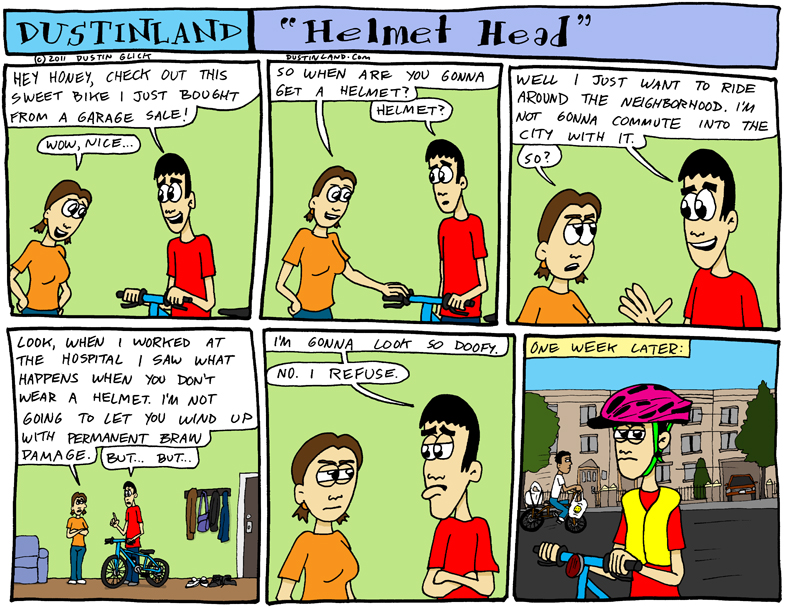
Besides, I would rather be eating pizza than visiting people in hospital (or attending funerals). And so I ask you to ensure that you always wear a helmet when you are riding or scootering and please take care!
You never know when you will have an accident.
Because they usually happen when you least expect it!
-Leslie
P.S this post is sponsored by Carey Davis at learninghaven.com. Thanks to this post, a young girl named Lisa is going to get pizza! Not just her but the whole group! Yay! How could anyone say no to that? Enjoy your pizza! This is not just one link, but a whole blog post dedicated to you!
I suggested that she share this with you because it had such great information and I also want to impress upon all my students that by reaching out and simply asking others, like yourself, things can be accomplished that the girls might not otherwise think can.
Would you please add the link to that resource for them to your webpage? They would be so proud to see that you included it. I also don’t think it hurt that I promised the group a pizza day if you did! Please let me know if you’d be willing so I can share the exciting news with them!
Thank you very much in advance.
Carey
————–
Carey Davis davis.carey@learninghaven.com
Teacher | Volunteer
Behold the tortoise that only makes progress when it sticks its neck out!
As you probably know I previously owned a business renting out top-quality bikes in Tenerife, Canary Isands [unfortunately that is no longer operational, but the website still works]. And I also sell the world’s best cable housing for bicycles. So I am still directly involved with the bike industry, and I have been an avid cyclist for at least 20 years.
But the trouble with the bicycle industry today is that all of these hybrid composite materials cannot be easily recycled, recovered or reused. It wouldn’t be quite so bad except new standards are introduced at such a rate, they drive frames and components obsolete within only a few short years. What is the expected lifespan of a frame today? It used to be ten years or more.
The reason I first rode a bike to school (almost 25 years ago now) was not just for enjoyment and practicality, but also for the environment. I think the bike industry is falling behind in that respect… way, way behind. The industry is all too keen to introduce new wheel sizes, new bearings, new fangled ways of attaching seatposts, new axle widths. I’m still waiting for the humble pedal thread to get superceded. It’s… it’s… it’s an entire industry.
And most bike magazine reviewers certainly don’t help the matter either. Why? Because they encourage people to buy ever more shit that they really don’t need. Why? Well, because if they don’t, they’d be out of a job, that’s why. What makes me say that? Because they get a lot of revenue for bike component advertising. And no component manufacturer in their right mind would advertise with a company that promotes minimalism, would they?
One of the very attractions of bicycles is that they are supposed to be «eco friendly». When frames only last a few years because of the introduction of new standards, I think adults are forgetting why they started buying quality things to begin with. I think we’re forgetting why we all got into cycling in the first place!
One of my most memorable rides of all time was riding around Bora Bora on an old French steel bike. The thing only had one speed, but I enjoyed that ride more than all of the others I can remember. So we don’t always have the most fun or even the best experiencex on the most advanced bicycles.
I actually think bicycle companies should be more like Calfee Designs. If I could have my time in Tenerife again, those are the bikes I would buy today. Take a look:
Last week I accidently updated wordpress without thinking and it automatically wrote over the top of some of my cutomised theme files.
In addition, I don’t think the newest version of wordpress was compatible with the old version of the theme I had, which dates back to 2009.
I guess I’ve been spoilt by my other much newer sites & wordpress installations that tend to see to themselves.
It’s been a few years since I updated the site, so basically the whole website went down, displaying some cooky error message like this:
Fatal error: Call to a member function hook() on a non-object
It takes a lot of work to be a website administrator. When things go wrong, they can really go very wrong.
Quite frankly, because tenerife-training.net is not my main priority at the moment, I just left it that way for about a week until I could find the time to investigate the cause.
The good news is that I finally have it back up and running again! Yay!
The bad news is that some of the custom style changes I made are gone.
It sucks because right around that time, someone was interested in buying the website off me. So I don’t know if the site going down had anything to do with it, but I never heard from them again…
I will need to reupload some from backups, but I am getting tired after working on this problem for about 2 straight hours.
So I will hack the code back to the way it was over the next few days… and it should be restored pretty much as it was.
I’ve had this post sitting in draft format for almost two years. It’s not an easy subject to write about. You see, earlier this year, I read the book «cradle to cradle; remaking the way we make things». It’s essentially a book about sustainable product design. I like to think of myself as an environmentalist. And I like to think of myself as a product designer too. So to me, this was one of those truly life-altering books.
I have always want to design and manufacture parts. Ever since high school, I can remember sketching time trial frames with aero cross sections. So reading this new book came as a bit of a shock to me. Because this was the first book that I read that questioned the status quo. It questioned the ‘sustainability’ of many of our current manufacturing processes. And the truth is, they are not very sustainable at all. I think we already knew that. But we don’t like hearing it. We block our ears or change the channel.
Previously, I used to only think about what things were made of. I would simply select the products that were made with the best materials (because I am a materials scientist). And that was it. I didn’t really question where all these materials even came from (although deep down I knew because I had studied it in subjects like «extractive metallurgy»).
Basically, we have got a big problem, because we are operating like there is no tomorrow. And it’s not good for the environment. Not good for the environment at all. Eventually, I think we’re going to reach a peak production volume. After that, I believe we must begin to produce less. Not just with bike products, but with everything. I predict that our entire global economy will be forced to sell more ‘services’ in lieu of ‘products’.
And I think the bicycle industry needs to look at itself very hard. Because it is making products and components that are bad for the environment. Aren’t bikes supposed to be good for the environment? Isn’t that why we all got into bikes in the first place?
With road bikes: How is hydraulic fluid good for the environment? What happens to all those disc brake pads when they are worn out? How is electronic shifting good for the environment? Indeed, how is carbon fibre as a material good for the environment?
I’d rather not be the one to tell you this, but carbon fibre composites are actually terrible for the environment. When you think about it, carbon fibres are not easy to make, are they? And the more forming processes they go through, the worse it is for the environment. There is more pollution. There is more energy required. More machinery is required. And what about the matrix, epoxy resin? That’s another nasty material. And these two phases, the matrix and the fibres cannot be readily separated for recycling when their life is over. Can they?
And what about bike frames? When a carbon frame cracks in two (and yes I have seen it happen), do we really repair it? Or do we simply throw it in the bin? I didn’t know what to do with my last pair of carbon tubulars when they wore out, so eventually I decided to cut them up into quarters and sold as «ultra-lightweight coathangars» (I have always tried to be zero waste). Yes, really! Someone out there now has a cupboard with a set of very expensive zipp 303 coat hangars!
So where do all of these carbon fibre parts normally end up? Land fill. That’s hardly what I’d call an advanced civilisation, making millions of things that make a one way trip to the bin.
With mountainbikes: How is continually developing new products year after year after year good for the environment? How about longer product cycles and real improvements please?
This is something I saw first hand renting bikes on Tenerife. The wastage was multiplied by a factor of 10x or 20x (or more) over a single rider. It’s not something you normally think about. And quite frankly I got tired of seeing it. One bottom bracket standard after another. It just makes it so much harder to keep spare parts… and more ends up in the bin, which is not good.
I think people must eventually come to realise that metals, ceramics and polymers must all come from somewhere. And where do they come from you ask? Well, they come from mines, that’s where. So every time you buy something new, you are destroying a part of the world. That is literally no exaggeration. It certainly doesn’t do the environment any good. Even when you buy an ecological vehicle, the raw materials must first be mined. So ultimately, buying nothing is almost always the best option.
The introduction of 29″ wheels was really one of the last straws as far as I was concerned… how are they any good for the smallest riders? And then as if to really fuck everone over good and proper, along came 27.5″ wheels. So these days I am just completely over it. I am happy with the bikes I’ve got and no one is going to convince me otherwise.
Now, I understand things must move forward and improve, but are these new inventions really ‘proven’ before they see the light of day? Or are they just design fads? I think product designers these days face a real challenge, and that is to make products that not only function well, look good and are reasonably priced, but ones that don’t harm the environment either. We are at the stage now, where that has to be considered. It just has to.
Half the problem lies with magazine editors. Yes, magazine editors. Because they often talk you into buying stuff that is simply not necessary. They do this because if they didn’t, they wouldn’t get as much advertising revenue, would they? There is a fundamental rule in many industries (not just the bicycle industry): you cannot speak ill of a manufacturer if they are paying your wages. It is like biting the hand that feeds you.
Not only does all of these mostly bullshit new products make your old ones go obsolete faster, but their manufacture taxes the environment more and more and more. So for every new carbon fibre part that is produced, new moulds must also be produced. The new moulds then have to be designed and fabricated. And those moulds must also be transported, too. And the transportation is happening with unsustainable transport methods, isn’t it? Right? That’s why I say the world today has got itself a massive problem. And I think it is one reason why so many people are depressed. It also explains why so many people in the manufacturing industry are climate change deniers, because if they admitted to it, then they would have to face a real dilemma that they are contributing to a worser future this Earth.
SO if you haven’t guessed already, one of my goals or aims in life is «to have a minimum impact on the environment». And I have an interesting story little about how I figured that out as well —I went on this horrible blind date and it turns out to be more like a job interview. You know, with fifty or more questions. And one of the questions was: «what is your aim or goal in life?» I was a bit taken back that someone would actually ask me that on a first date. Anyway, after a lot of thinking, we honed in on my life goal together. Well at least I got something out of it I suppose. LOL.
So I have an announcement: last year I started a new blog, called vida enigmática: «who speaks for Earth?». I hope to influence and inspire more people over there. Hopefully a whole generation, young and old, will tune in and take notice. I personally hope that it starts a revolutionary new way of thinking, so I hope to see you there.
I might as well add this here now, because I don’t update this blog much anymore. So the other site I have been working on is this one: my illustration and photography website.
And my inspiration these last few days has been none other than Bradley Manning. Reading through the chat logs, it’s clear that he has some issues – yes I’ll certainly admit to that. Perhaps it is because he was basically a social outcast that he himself felt betrayed. The irony is that a man so small [physically] could do so much ‘damage’. If anyone, Lamo is the real traitor / liar here.
To me he is one heck of a courageous and empathic individual. I believe that yes he knew the shit would hit the fan, but he had the balls to do it anyway. He put himself in the place of those innocent men and children in Iraq and that my friends is highly commendable. It shows perspective. And perspective is what the US is in dire need of at the moment.
The terms ‘betrayal’ and ‘traitor’ should only be used if he attacked the US, which he did not. I mean, did he join the taliban, take a gun and start shooting at US soldiers? Did he sell weapons to them? I think not! So «aiding the innocent» is more like it…
Oh and why the heck were my wikipedia edits about Bradley Manning’s troublesome early life promptly removed? That does influence his actions as «experience affects behaviour». Every socialogist knows that. There’s clearly a major coverup / conspiracy going on here. Why the heck is there no jury in this trial? Is it because they would be split? I think so. Seems to me that yes the US is involved in war crimes, yes they are breaching several of the Geneva Conventions. And no I won’t be visiting there again.
«They dehumanized the individuals they were engaging and seemd to not value human life … For me this seems similar to a child torturing ants with a magnifying glass.» Bradley Manning
Wouldn’t it be great if we all had top-down radar view of all oncoming traffic in our cars just like they have in those little learning to drive manuals? That way we could effectively ‘see’ around corners and we could drive accordingly. It’d also come in extremely handy when parking wouldn’t it? Well until it arrives, here’s my advice: if you can’t see around a blind corner, don’t risk any fucking insane overtaking manoeuvres!
Yes of course you’re supposed to give cyclists a full metre or more of space when overtaking. Here in Spain, it’s the law. Now here’s the catch:
Unlike somewhere like Australia where the continuous white and double white lines are seen as some kind of imaginary vertical wall which can and will not be traversed under any circumstances, you are in fact allowed to cross this line in Spain under ‘special conditions’. One of these conditions is overtaking cyclists, with the proviso that you can see what is coming and you’re not endangering either the cyclist or oncoming traffic. So to put it simply, yes you can legally wander into the oncoming lane – but only when it’s safe to do so. Do I even need to spell out that «safety is never guaranteed around corners»? That is why you’ll see drivers in Tenerife patiently waiting there turn to overtake cyclists. They only do it on the straight & level bits of road (i.e. not on the crest of a hill where you can’t see anything either). SO IF YOU FIND YOURSELF ON THE OPPOSITE SIDE OF THE ROAD AND YOU HAVE AN ACCIDENT AS A RESULT OF BEING THERE, IT’S YOUR FAULT. YOU CAUSED THE POTENTIALLY FATAL HEAD-ON COLLISION. NOTHING MORE REALLY NEEDS TO BE SAID. Why? Because driving safely is all about being predictable. And, for example, meeting an oncoming car in the wrong lane, not just anywhere, but at the apex of blind corner is not really very predictable. Is it?
It sounds pretty simple, right? Not for some… [Read more →]
It looks like the new highway between Adeje and Santiago del Teide has been delayed again. However, governmental funding has been approved, work can now continue and hence the expected completion date has been postponed until the end of 2013. This coincides with another part of the island loop («anillo insular» in Spanish), the stretch between Icod de los Vinos in the North of Tenerife and Santiago del Teide. The two new roads represent a 400 million euro investment for the island of Tenerife. [Read more →]
For those of you thinking about renting a car in Tenerife, I think it’s a great idea. If you’re a cyclist wanting to make the most of your cycling holiday, or just a casual tourist, hiring a car allows you the freedom to go wherever you and want, whenever you want. It’s surprisingly cheap to rent a car here too! Before you go ahead, I do have a few recommendations as far as local driving culture is concerned…
The roads on Tenerife are something else. Even though everything is well signposted, driving here isn’t what you’d call ‘easy’. In fact, the word «extreme» comes to mind, because there are almost no flat or straight roads here. Now, with that in mind, know that local drivers are accustomed to driving on these roads over and over and over again, hence most of them get a tremendous amount of practice driving on this little island. See where I’m going with this…? [Read more →]
Preface: This article is turning out to be very difficult to write. Part of the reason is that I began writing it when I was suffering from depression myself. Hence, my motivation was a lot less than it is now. Depressed people also have a slanted or warped perspective – they have an extremely negative or pessimistic outlook on life. This is something I wanted to take advantage of during the time that I was «infected» with the disease. During this phase I wrote some paragraphs which seemed to retain that negativity, but they weren’t written well. I can tell from my own words now that I was struggling with everything.
Yet I normally enjoy being an optimistic person, always thinking very positively. So it’s challenging for me to write now because I’m cured (at least temporarily)! This didn’t happen overnight – it was a gradual process over several months, gradually transforming from pessimist through to optimist. I’ve had this article in draft form for some time now and just want to present the idea to you as part of the section «Vida Enigmática». Let’s just say that it’s not a prediction. It’s a possible future scenario. Hyper-optimistic people will definitely not be able to relate to this article – they simply will not be able to comprehend the situation I describe below. [Read more →]
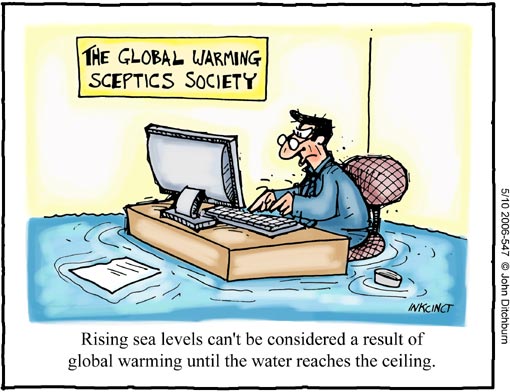
Do you notice the terminology «global warming» is somewhat detached from the humanity that caused it? As if it were the planet’s response to our domination, but not directly our own fault.
Deforestation today proceeds at 55,630 to 120,000 square kilometres each year. At this rate, all tropical forests may be gone by the year 2090.
I think the real reason why some people continue to deny global warming is taking place (subconsciously or not) is that they can’t deal with reality. So if they convince themselves that it would’ve happened anyway, they can simply carry on life as normal, and not have to worry about it.
For me, the notion that this is all some part of a repetitive ‘prehistoric cycle’ which man has nothing to do with is preposterous. It just happens at the same time man enters the industrial age, and is happening 10x quicker than anything before. Hello! coincidence!! The words RATE OF CHANGE have very strong meaning in the scientific community. Grand geological transformations don’t just happen over a matter of years or even decades. They are supposed to take millenia, or longer. So now that the average global sea & air temperature has risen a degree already, I think we’re already in deep shit my friends. [Read more →]
If you’re truly open to another culture, then once you move out, you’ll never look at your homeland the same way again. Because you’ll soon be able to recognise the faults or flaws that exist in your own country. You also won’t be so quick to take for granted many things that you might have done before. Be prepared to literally become a different person. If you have always felt like you don’t fit into your own society and secretly wanting to expand your horizons, that’s the best reason to distance yourself from it.
On the other hand, if you’re a stubborn person not open to change, then you probably won’t gain much by living somewhere else. Moving to a place because it has sunny blue sky is a pretty shallow reason to settle in another country, especially if it means you have no incentive to integrate. Really question your motives for moving to another culture. If you have no interest in learning Spanish or any other foreign language and your only intention is to take advantage of the local people, then you’ll only find deep-rooted resentment amongst them.
One problem expatriates persistently face is that you can never really experience both places at the same time. You’re either in the one place or the other, living one of two different «life modes». It’s commonly believed that you can look at everything with two alternative yet opposite perspectives: optimistism and pessimism. It is my belief that living in another country amplifies the bipolar nature of this thinking pattern. What happens first is that you’ll constantly be comparing your new home and your old one and then asking yourself if your decision was the right one. You can either look at the big move as something positive or negative. [Read more →]
I’ve had this draft here lying around for too long so I thought I’d share it. I believe these are not my own words, but I think being aware of several current theories about stress is interesting in light of one of my other posts.
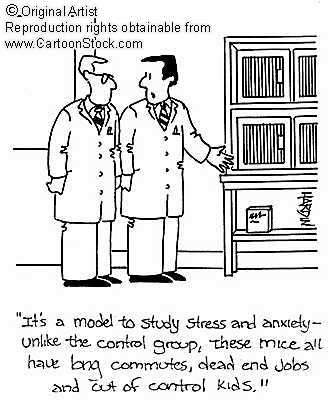
Hans Selye , one of the foremost stress scientists, found that stress uses «adaptation energy» that depletes us of our resources. He also found that, in general, stress is good but that it turns against us when it is uninterrupted.Alvin Toffler , a sociologist, found that in our present society many suffer from over-stimulation, too many changes, cognitive overload and decision overload, while our classical means of coping are not adequate for these conditions.
Rosenmann & Friedman , MD’s, studied their patients personality and the incidence of their heart attacks and found that an ambitious (type A) personality had seven times the chance to have a heart attack than the more easygoing (type B). (The only problem with the B’s is that they may be disaster prone). It can be said that stress is caused by poor timing of external changes in combination with an exaggerated internal perception.
Holmes, a psychologist, related illnesses to changes that took place in his patients before the illness. From this he developed his «Stress scale», which lists changes in order of resulting stress. Then he concluded that change is not random, but a combination of fate and choice; therefore, change mangement is possible.
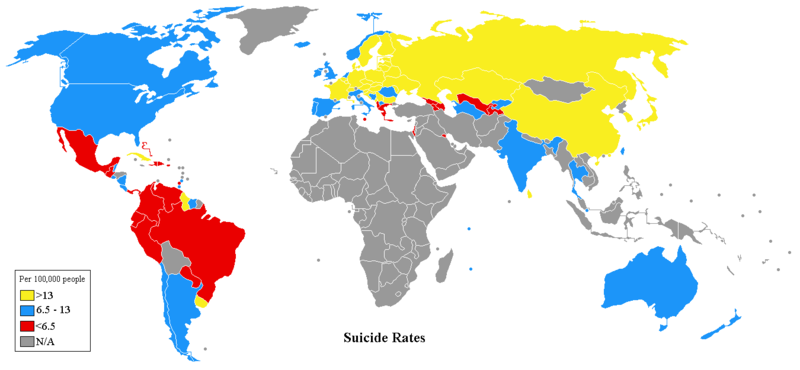
According to the World Health Organization (WHO), someone around the globe commits suicide every 40 seconds. In the year 2000, 815,000 people lost their lives to suicide — more than double the number of people who die as a direct result of armed conflict every year (306,600). For people between the ages of 15 and 44, suicide is the fourth leading cause of death and the sixth leading cause of disability and infirmity worldwide.Source.
Everyone has usually heard at some point in their lives that one country has the highest suicide rate in Europe or the world. Most people think it is either Finland or Japan. In fact, the Innu people in Canada’s northeastern regions have the highest suicide rate in the world: 178 per 100,000 persons per year. To put this into perspective, Finland has an equivalent suicide rate of 31.7 per 100,000 and Japan 35.6 / 100,000.
Statisitics reveal that, yes, some cultures are more prone to suicide than others. I find this idea morbidly intruiging. Why? Because it means that people can be prone to «losing hope» when placed in different environments. And since cultures are not static but dynamic entities, the implication is that the rate of depression could change in the future. It is my firm belief that NONE of us are completely immune.
The suicide rate immediately following the 1929 stock market crash (October 24th -29th) does not appear to have altered significantly. However, there does appears to be a surge in the suicide rate starting around three months after the onset of the initial stock market crash. That three month delay is the time required for the onset of this condition.
Consider the following information:
Overall, the total population three-year moving average suicide rate peaked in 1927–1929 (18.5 deaths per 100,000 population). After that point, the suicide rate dropped and then stabilised, with slight fluctuations, until 1971–1973 (10.2 deaths per 100,000 population). After 1971–1973, the suicide rate increased again, reaching another peak in 1996–1998 (16.7 deaths per 100,000 population). After this point, the suicide rate declined up until the most recent period, 2001–2003 (14.2 deaths per 100,000 population) by 15.0 percent.
These dates appear to be consistent with the 1929 stock market crash, the 70’s oil crisis, and more recently the dot-com crash. I’m predicting that before the end of this year (2008), the suicide rate will rise again considerably, due in part to the September 2008 global financial crisis.
The majority of my readers are Americans, so I’ve decided to quote some pertinent statistics gathered by the Centre for Disease Control and Prevention. In the United States of America:
There are 89Â suicides per day in America. This is equivalent to a suicide rate of 11.05 per 100,000 population.
Among young adults ages 15-24 years old, there is 1 suicide for every 100-200 attempts.
Males take their own lives at nearly 4 times the rate of females.
Among the general population, suicide was the 11th leading cause of death.
Suicide is the 2nd leading cause of death among 25-34 year olds and the 3rd leading cause of death among 15-24 year olds.Â
Suicide rates among American Indian / Alsaskan Native adolescents and young adults ages 15 – 34 are 1.9 times higher than the national average for that age group.
Hispanic female high school students in grades 9-12 reported a higher percentage of suicide attempts (14.9%) than their White non-Hispanic (9.3%) or Black, non-Hispanic (9.8%)Â counterparts.
I wonder what the possible contributing factors are towards a culture’s suicide rate?
Risk factors for suicidal thoughts, plans and attempts are consistent across countries, and include having a mental disorder and being female, younger, less educated, and unmarried. So says new research from a Harvard University professor and the World Health Organization (WHO) World Mental Health Survey Initiative. The study examined both the prevalence and the risk factors for suicide across 17 countries, and is the largest, most representative examination of suicidal behavior ever conducted.
The survey included data from 17 countries: Nigeria, South Africa, Colombia, Mexico, USA, Japan, New Zealand, China, Belgium, France, Germany, Italy, the Netherlands, Spain, Ukraine, Israel and Lebanon. A total of 84,850 adults were asked about suicidal behaviors and socio-demographic and psychiatric risk factors.
Previous studies of suicidal behavior have largely relied on smaller, self-selected samples of suicidal individuals, and so it has been unclear how well the results would generalize in different countries around the world. This study is the first to examine the thoughts and behaviors of individuals across numerous, diverse countries.
«Our research suggests that suicidal thoughts and behaviors are more common than one might think, and also that key risk factors for these behaviors are quite consistent across many different countries around the world,» says Nock.
Across the countries included in the study, risk factors for suicidal behavior included female gender, younger age, fewer years of education, unmarried status and the presence of a mental disorder. Additionally, the risk of suicidal thoughts increased sharply during adolescence and young adulthood in every country studied.
The strongest risk factor associated with suicidal thoughts and behaviors were mood disorders in high income countries and impulse control disorders in low- and middle-income countries.
«We often think of suicidal thoughts and behaviors as occurring among people who are depressed, but across all of these countries, we found that it is not just depression that increases the risk of suicidal behaviors – impulse control disorders, substance use disorders, and anxiety disorders all are associated with a significantly higher risk of suicidal thoughts and attempts,» says Nock.
In fact, this study showed that among people with suicidal thoughts, the risk of making an attempt was highest not among those with a mood disorder, but in those with substance abuse and impulse-control disorders, suggesting that these disorders are most strongly associated with acting on suicidal thoughts when they are present.
Suicide is a leading cause of death worldwide, but information on its prevalence and risk factors is unavailable in many countries, particularly in those that are less developed. Currently, resources devoted to the treatment of mental disorders and to suicide prevention are lacking in many countries. Further research could help to explain the differences in prevalence of suicide thoughts across different countries, Nock says.
As you are probably already aware, if you’ve tried to access this website in the last week, it hasn’t been available most of the time. It was either extremely slow, full of errors or showed an «account suspended» message.
This was because my entire web domain was subject to a prolonged Distributed Denial of Service Attack (DDoS). Now up until a few days ago, I had no idea what this was. It’s basically a webmaster’s worst nightmare, that’s what it is… because I soon found out it’s one of the best way to bring a website down and simultaneosly get banned from your web hosting provider. [Read more →]
When I was younger, around 25 years old, I simply did not believe that depression was real. Being a hyper-optimist, I was one of those people that denied that it even existed, I used to tell my mother that it would never happen to me because I have always been a positive thinker (I ‘inherited’ this personality trait from my father).
Little was I to know that only a few years later, I would suffer from a terrible bout of depression. It was enough to make me cry & sob every single night. At one extemely low point I remained physically paralysed by this condition. It was precisely then that I seeked out professional help. Yes, I openly admit that I’ve taken prozac and other chemicals – and yes I believe that on the surface they do seem to work quite well. But no I don’t think they are a miraculous and permanent wonder cure. [Read more →]
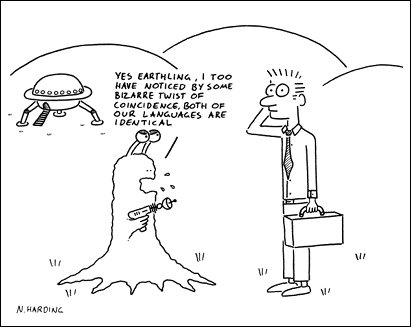
Living outside of your own country is never that simple. What could be more challenging than to live in a strange new land and foreign culture? While travellers have it easy, I think that it is particularly difficult for expatriates. Obviously the greater apart the host & donor countries, the harder it becomes.
In my case, I was born in Sydney and resided there for the next 27 years. Yet Tenerife is the opposite Sydney in just about every respect. We drive on the wrong side of the road, the geography of the islands are totally different, the seasons are completely reversed and both places are at the antipode. [Read more →]
So I woke up today to find that the website didn’t seem to be working properly. Here’s the full damage report:
The main website is missing all the contact information + navigation bar, my two subsites www.BikeNode.com and www.ProBikeHire.com are completely offline, the last two days work has disappeared completely from existence and the web hit counter on the homepage doesn’t appear to be counting anymore.
Suprisingly, both the forum & blog (which are normally very susceptible to these kinds of changes) are working perfectly.
I eventually found out that this is due to the host provider changing servers. An analogy? Well, this is like waking up and finding that your landlord has moved all your stuff while you were sleeping -with no prior warning!
I just wanted to say that I’m already tackling the problem but at the moment it’s beyond my control. At least I’ve updated the homepage with the nav bar.
Western society totally idolises an athletic body shape but resents the physical exertion required to attain it. We try to minimise human physical work by any means possible. As far as I’m concerned, every time you switch on any form of electrical equipment, you’re basically signing an invisible contract that reads:
«I accept that as a consequence of using this device, I risk becoming physically and/or mentally unhealthy»
We choose to avoid using our muscles at each and every oportunity and then suddenly wonder why we’re obese. We drive to work, drive home and then drive to the gymnasium (if at all). Most of us have even become too lazy to cook or make anything for ourselves – we invent power tools & kitchen utensils to do it all for us. Take this scenario for instance:
Rather than whip a cake using a wooden spoon the old-fashioned way, we’d now sooner collectively sit in front of a computers all day long, earn enough money for a mechanical cake mixer which can do it for us (basically employing a whole host of product design engineers, entrepreneurs, the sales & marketing department, and everyone else who works in the wholesale and retail chain). [Read more →]
The worlds’ gone stark-raving mad. You hear responses like this to absurd news stories spoken every single day. What exactly am I referring to? I’m referring to insane cases of «personal rights, freedoms and civil liberties» in the simultaneous «age of political correctness». These two forces do not belong in the same time zone and space. It’s like matter and anti-matter, except that as soon as they come into contact, good old common sense implodes along with them.
Young people these days that claim they have the right to steal, vandalise, assault, rape, abuse, and generally do whatever the bloody hell they feel like. Okay, but then to compensate for their illegal behaviour you expect some sort of justice. You expect that when they get caught, they’ll be reprimanded by the full extent of the law. Not so. Instead, they go and slip on some marbles while robbing the plasma telly inside an innocent person’s home and sue the owner for negligence. [Read more →]



 Living outside of your own country is never that simple. What could be more challenging than to live in a strange new land and foreign culture? While travellers have it easy, I think that it is particularly difficult for expatriates. Obviously the greater apart the host & donor countries, the harder it becomes.