Down Under in Tenerife

Map of Australia | Living at the antipodeLiving outside of your own country is never that simple. What could be more challenging than to live in a strange new land and foreign culture? While travellers have it easy, I think that it is particularly difficult for expatriates. Obviously the greater apart the host & donor countries, the harder it becomes.

In my case, I was born in Sydney and resided there for the next 27 years. Yet Tenerife is the opposite Sydney in just about every respect. We drive on the wrong side of the road, the geography of the islands are totally different, the seasons are completely reversed and both places are at the antipode. [Read more →]

Kompass 233 map of Tenerife | Teneriffa Karte MTB

MTB and hiking map of Tenerife | Kompass 233 Karte mit Lexikon und Stadtplänen. Wander Bike Freizeit und Straßenkarte.This is by far the most detailed tourist map of Tenerife at a scale of 1:50,000. The Kompass 233 map contains all the major mountainbike trails and walking tracks. Altitude contours are shown at 100m intervals so it’s ideal for both hiking and mountain biking. You can’t get any more detailed without getting one of the expensive official Spanish military maps.

There’s a multi-lingual legend showing imporant points such as: alpine shelters / refuge huts, hospitals, parking, information, lookouts, museums, monuments, climbing walls and even surf spots! Suggested MTB routes are outlined with blue dots.

This map includes the following inset city maps: Puerto de la Cruz, La Orotava, Los Cristianos, Playa de Las Américas, San Cristóbal de La Laguna and Santa Cruz de Tenerife. There’s also a Tenerife guide, but alas only in German (even so, it’s worth every cent).

I now sell these Kompass 233 map of Tenerife for €13.50 and can post them anywhere in the world for only €4.50.


As with all large-scale maps, there’s only one right way to fold it and many wrong ways… so if you’re looking for something easier to manage, one of the only other road maps of Tenerife I can recommend which is also suitable for road cycling is the Freytag & Berndt 1:150,000 Teneriffa map. It’s smaller, plastic coated and much easier to fold than this blanket.

Freytag & Berndt map of Tenerife. Teneriffa Karte

Freytag & Berndt Tenerife Teneriffa 1:150000 scale map. ISBN 978-3-7079-1079-7This is the best road map of Tenerife for cyclists; it contains all the major and secondary roads and even some offroad tracks.

Roads are laballed with the standard “TF” designations and include kilometre markings between major towns. This definitely isn’t a topographic map but there are several altitude points referenced. There’s also an inset map of the capital city, Santa Cruz. The best thing is that it’s pocket sized and plastic-coated so it won’t disintegrate in that sweaty back pocket of your cycling jersey!

There’s also another 1:75,000 version of the Freytag & Berndt Tenerife map; it has a cardboard cover but it is too big to fit in your pocket & doesn’t contain any more detail than this one (apart from the altitude contour lines). Unlike its big plain-backed brother, this mini-map contains some extremely brief tourist information on the reverse side (in ten languages!).

I now sell these Freytag & Berndt maps of Tenerife (1:150000) for only €5.50 and can post them anywhere in the world for only €3.00.


If you’re looking for the best MTB map of Tenerife with all the offroad tracks, I strongly recommend the Kompass #233 map instead. It’s probably too large for road cyclists though and very difficult to fold up again correctly.

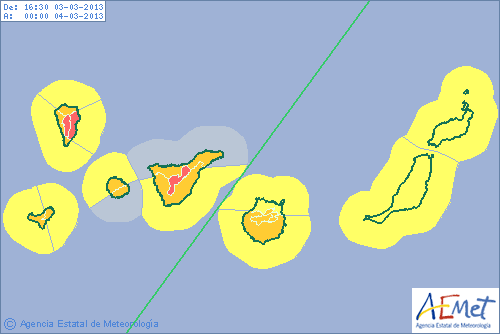
Tenerife weather alert.

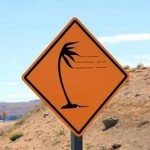
Tenerife weather alert. Tenerife weather risk. Tenerife tropical storm predicted.Tenerife is currently in a heightened state of weather alert with the official title “important risk”. (there are four increasing levels: “without risk”, “risk” “important risk” and “extreme risk”). Firstly, rain is predicted at 30 - 60mm per hour depending on the zone in Tenerife. Secondly, wind gusts up to 90km/hr. Thirdly, storms are predicted.

Locals will tell you that the weather is “ugy” and the South of Tenerife has been very windy in the last few days indicating that a tropical storm is due. This is more of a prelude to a real danger although bike riding is not advised at this time as you could get stuck out there in some really nasty weather.

Volcanic hazard zones in Tenerife

Volcanic hazard map. Danger zones in Tenerife, Canary Islands.I recently found this while surfing the web for a good map of Tenerife. The map legend explains all the specific danger zones in tenerife, a volcanic island here in the Atlantic ocean.

Lance Armstrong & Alberto Contador will train together in Tenerife! Team Astana in Tenerife this November!

Lance Armstrong & Alberto Contador ride together in the Astana training camp in Tenerife.Alberto Contador, winner of this season’s Giro de Italia and Vuelta a España confirmed his continuation with team Astana next season alongside his American team mate Lance Armstrong. Contador assured that the Astana team will prepare in Tenerife at the end of November 2008.

“I’ve been analysing the diferent situations and thinking about alternatives since half way through the Vuelta and after meeting with my director, Johan Bruyneel, and having spoken of the last few months, we have resolved whatever type of tension between us”, said Contador.

Astana Team Logo. Armstrong to train alongside Contador in Tenerife in preparation for the 2009 cycling season.“We have already spoken about what my schedule will be in the next season and consequently, I can affirm that I will be in team Astana next year”, added the spanish rider. “I have taken the decision to keep going because I think that it’s more certain, since I can count on a great group of trusting men around me who have done their best with me in each race and that should permit me to keep fighting for victory with the best guarantee”, explained Contador.

Team Astana training in Tenerife. (AP Photo/Arturo Rodriguez)The arrival of Armstrong has been the main cause of friction. “I think that everything is going to perform much better than what it appeared to in the beginning. If each one of have our own agenda there won’t be any type of problem or inconvenience. For me it’s a pleasure to coincide within the same team as a great racer who I’ve always admired”, he said. “It’s also true that I am ambitious and when he established that he wanted to win his 8th tour, I thought that co-existence would be complicated, but I think that with a good team management there won’t be problems in France. For the rest of the year, it doesn’t inconvenience me”, he continued.

Lance Armstrong trains in Tenerife, December 1st. AP Photo/Arturo RodriguezAlberto Contador is still finalysing his race calendar for the next season. What seems decided is that he will race the Tour in the biggest three weejs. “My idea is to race only in the Tour at 100%, because this year it’s hard for me to recover from the strength of the Giro and the Vuelta”, he assured. Contador still hasn’t spoken directly with Armstrong. “We have a training camp in Tenerife at the end of November and there we will speak with our directors to avoid any type of arguments, because perhaps there has been an excessive expectation with all this, even though it is understandable”, he said. [Read more →]

“Tenergrief”

The future of Tenerife conservationThe rate of construction taking place in Tenerife is mind-boggling. Just 50 years ago, before mass-tourism, the whole La Orotava valley was cultivated land. Today, pretty much every space below about 500m altitude has already been urbanised to some extent. It has one of the highest population densities of anywhere; the average figure is now 400-500 people / km², depending on how many tourists are present. In fact, if this island were a country, it’d be the 24th most populated country on the list… needless to say, I often feel a strange sense of agoraphobia. It’s not like a city, from which you can always escape. [Read more →]

Where do professional cyclists train for the Tour de France?

Where do professional cyclists go to train for the Tour de France and the Olympics?Many famous names in professional cycling come to Tenerife, including Lance Armstrong, Marco Pantani and Miguel Indurain. A longer list of professional cyclists that have trained in Tenerife can be seen here.

Tenerife is one of the seven Canary Islands, a volcanic island chain belonging to Spain. Tenerife is located in the Atlantic ocean, about 250km off the African coastline (Western Sahara).

Tenerife, the world’s third largest island volcano, is an ideal training destination for serious cyclists as there are several continuous 2300 metre (7000 ft) ascents which commence from sea level. Mt Teide, rising to 3718m can often be seen rising above the surrounding terrain.

Many professional cyclists choose to train in Tenerife during the winter season when the rest of Europe experiences much cold temperatures. The Canary Islands are generally regarded as the Sothern-most part of Europe; Tenerife’s local climate is obviously a lot milder than what the European mainland experiences, even despite the mountains. So much so, cycling in Tenerife is possible all year round.

Professional cycle training camps are often based at Las Cañadas in the centre of Tenerife. El Parador, the only hotel allowed within the entire El Teide National Park, is located at an altitude of 2100m. From here, cyclists are able to become accustomed to high-altitude training within the surrounding volcanic crater; the elevation in this region always exceeds 2000 m.

Spanish food and eating customs:

How to eat Spanish food; Spanish eating customs.- A typical Spanish breaksfast consists of an expresso coffee … and that’s often all there is to it.

- The main meal is usually served between 1:00 and 2:00pm in the afternoon. This is sometimes accompanied by a first course consisting of soup. Three course lunches are the norm for the all-important weekend family get-together.

- Parsely is the mother of all herbs in Spanish cooking. I’m willing to bet that more parsely is consumed in Spain than all other [cooking] herbs combined.

- Spanish rarely eat outside their homes (or at least here in the Canary Islands). The proper place to eat is in the kitchen, while the dining room is sometimes just left for show.

- For some unknown reason, if you’re sharing a plate of food, especially tapas, the fork is left resting perpendicularly on the edge of the plate, with the pointy side curving down. Don’t ask me to explain this strange custom. [Read more →]

Spanish fashion oddities:

Spanish fashion tips. How to be cool in Spain.Supermodelo 2008 got off to a quiet start as Operación Triunfo gathers even more momentum here in Spain. The popular Supermodel contest usually rebounds once the Operación Triunfo wake surges (or at least it did last year). But honestly, I don’t know what to make of Supermodelo 2008 this year; half the instructors are in fact French! Readers will be left wondering if there is anything at all to Spanish fashion. Leave that to me. I’ve recently gathered together many un-hitherto unrelated thoughts during my stay here in Spain, and compiled this list describing just what is popular in the world of Spanish fashion:

  • Any English words printed on T-shirts. It doesn’t matter what words are printed, they’re just cool. Partly because to be in a position to buy a foreign T-shirt, you have to have travelled somewhere.
  • Car tattoos have become fashionable. That’s right. Car tattoos. The average spanish car enthusiast can’t afford to upgrade what’s under the bonnet. Hence, Spanish hoons restrict their engine modifications & instead focus on the outsides of their vehicles. So you’ll see all sorts of customised designs stuck onto cars. It’s just a small part of what’s called “tuning”, but here pronounced more like: “toonin”.
  • The mullet haircut. I’m trying to work out whether mullet haircuts have made a comeback in Spain, or whether in reality they never went out of fashion! Whatever the case, rest assured that at least here in Spain, mullets are alive and well. They just don’t have a name yet.
  • I once heard my friend comment that yellow houses were “vasto” or “cutre” (in my time, the appropriate translation is “corny”). Most houses in Spain are either white or yellow and I’ve always wanted to know why.
  • Womens shirts with sleeves should have enormous neck holes to compensate for the increased skin coverage factor. If the sleeves aren’t falling off the shoulders, it isn’t fashionable enough. Think of it more more like a tube top encompassing the arms as well. (you can thank wikipedia for educating this simpleton about the many definitions of what shirt’s are and aren’t)
  • In Spain, shoes are everything. Spanish men are lucky enough to have a special subset of shoes which are admitedly very difficult to describe. I suppose they land somewhere between the simplicity of those older canvis tennis shoes and the sleekness of modern sneakers. I had to trawl through dozens of pages to come across this picture representing this particular slice of Spanish fashion.

¡Ni Papas! (Not even potatoes!)

Disaster potato losses in North Tenerife, La Orotava, Canary Islands. Catastrophic potato harvest; potato cultivation in crisis.For those of you who don’t know “ni papas” is a Canarian expression which literally translates as “not even potatoes” but really means “nothing” (I suppose because if you’re not even collecting potatoes, there’s nothing left). Usually it’s tacked on the end of a sentence; I’ve heard it used in the following phrase by my driving instructor: “Cuando hablan Inglés no entiendo nada, ¡ni papas!”. (When they speak I don’t understand anything, nothing!)

Normally I don’t bother translating local Spanish news because Pamela of www.secret-tenerife.com does such a fine job. But since we here at Tenerife-Training actually live on a combined potato/grape/orange farm, this story is right up my alley so I feel compelled to cover it.

In the North zone of Tenerife potatoes have been grown and harvested for at least the las two centuries. On April 24th 2008, there was a heat wave & the combined strong winds then wiped out up to 80% of production in the worst hit region of Benijos. The entire zone known as “Las Medianías” in the North of the Island was affected, especially the La Orotava valley. The losses vary between 70 and 80% of a normal harvest. These damages have been caused by the dehydration and defoliation of the plants. [Read more →]

The top 100 strangest search terms ever?

A list of the top 100 strangest search-engine phrases & google search terms.Many readers who do not host their own websites will not realise this, but yes, whenever you visit a website, the server records how you got there. What does this mean? Well, whatever you enter into google is usually stored by the host-server, and it is in fact all-too-easy for someone like me to peruse that list. Just for the record, it’s also possible to know in which order you viewed the web pages on my site, and how long you remained on each page.

Anyway, browsing through all the many search terms that people use to find this site has quickly become a regular little past time. Knowing what people search for and what is successful certainly helps with Search Engine Optimisiation (SEO). Most of the search terms generally have keywords such as “cycling”, “bike hire” or “Tenerife”. But here is a list of the 100 all-time most unique search terms I have encountered so far, really standing out above the remaining 13,000+ internet searches used to find www.Tenerife-Training.net. All these people entered my site by typing these exact terms into a search engine:

JUST PLAIN STRANGE SEARCH TERMS:

  1. “fish with big lips”
  2. “sea snake santa”
  3. “benedict alan climbed into a camel”
  4. “submarine for hire”
  5. “eggbeater review candy”
  6. “chocolate coated banana business”
  7. “in life some hoops you have to jump through will be on fire”
  8. “purple kettle” (21 people actually searched for this term in the last year alone)
  9. “crocodile initiation philosophy” 
  10. “crocodile scars”
  11. 2-oxo-l-threo-hexono-1 4- lactone-2 3-enediol
  12. “tired after eating turkey”
  13. “perspective of air resistance”
  14. “what do tongan people look like”
  15. “is soy good for nerves”
  16. ujmwutzckmkdwean

STUPID SEARCH TERMS:

  1. “i don t like turning left when the road marking makes me turn the car to the left”
  2. “what should u use for a 3 year old when driving a car” 
  3. “how much time do i spend in each place when traveling”
  4. “could it be a big world after all”
  5. “can you translate words and how”
  6. “safe to eat a rotten banana”
  7. “can you take shower gel in your suitcase now when travelling?”
  8. “how many chupa chups have they sold in the world”
  9. “the best inventions chup & chups”
  10. “are there cheap paintings by pablo picasso?”
  11. “earn twenty bucks now”
  12. “how much space does 11 million metric tons take up?”
  13. “how do computers remember the time”
  14. “how big is 6 000 000 000″
  15. “science learns you essential things for life?” [Read more →]

The “steepest street in the world record” disputed!

Worlds steepest street!The guiness book of records states that Baldwin Street in Dunedin, New Zealand is the steepest street in the world. According to the figures, the Baldwin St is 359m in length (horizontal measurement) with a total elevation gain of ~80m.  The plaque states that “over the 161.2 metre length of the top section, it climbs a vertical height of 47.22 metres, which is an average gradient of 1 in 3.4.1. On its steepest section, the gradient is 1 in 2.86. However, there is some dispute over this as only 6m out of the total street length at the steepest gradient.

I’ve seen Baldwin Street in the flesh and was somehwat disappointed - in fact the first part is almost flat! It then ramps up considerably towards the top section. Hence, the average gradient of the entire street is more like 1 in 4.375. That’s the trouble with New Zealand - they tend to exaggerate a lot. So I would like to challenge that record today by making yet another claim for the worlds steepest street:

Is this the “steepest street in the world”?After scouring over online topographic contour maps, I have chosen Calle Monroy in the district of Santa Ursula, Tenerife, Canary Islands, Spain. I do not possess a global positioning system (GPS) to accurately gauge its gradient. Nevertheless, we can estimate that the length of this street from the data provided by Google maps. Monroy Street descends from 638 to 430 metres in a length of only 740 metres. Therefore, the average gradient over the entire street is 28.1% (a slope of 1 in 3.56) compared to Baldwin Street with an average gradient of only ~22.3%.

The steepest street in the world.Besides, the photo to the left shows that the steepest part of the road has a slope with a ~40% gradient (caculated by the pixel method)! Now until some bright spark can come up with another street with a steeper average gradient, which can be confirmed, I’m going out on a limb and labelling Monroy Street the “steepest street in the world”, albeit unoffcially! Or if you prefer: “the street with the highest average gradient”. But I think the first one is more correct.

Oh and as far as I am concerned, taking slope readings only on the very steepest parts of the same street is cheating. If that were the case, I’d claim the inside portion of this street. Measured over a few centimetres, the gradient is technically about 80% over the length of one particular piece of aggregate!! Hell, you could probably even find a patch of tarmac with a slope greater than 100% on if you used a micrometer. Obviously, that’s not at all fair. For this reason alone, I challenge people to take the average slope over the whole length of the street. Take the reading from the very beginning to the very end of the same street, don’t leave any sections out, and neither can you add two or more street sections together. Also, I think it should be compulsory that the street has to have a name recognised by the local council…

World’s steepest StreetIf you take the entire length of the street and then determine the average gradient the way I propose, Monroy Street (Calle Monroy) appears to come out as the winner. This street does not have any flat parts; it is the steepest continuous grade sealed street with public access that I am aware of, also plainly visible in Google Maps.

OTHER CANDIDATES:

One other very steep street that I spotted also resides in the district of Santa Ursula. This particular street, which includes Calle Los Tosqueras for most of its length, descends from 1012 to 348 metres in a length of 2.5km, although the top section is not paved. Furthermore, Calle Los Tosqueras diverts horizontally while the steeper adjoining street has a different and as yet unknown name.

However, the neighbouring zones of La Corujera and Toscas de Ana María also provide many other possible candidates for the world’s steepest street. Camino el Monte, Calle La Calzada, Calle Las Turcas, Calle Los Castaños, Camino Los Pajales and Camino La Banderola are all noteworthy, boasting average gradients close to or exceeding 25% slope. Other extremely steep streets in the North of Tenerife worth a mention are Calle Argentina in Icod de Los Vinos and last but not least: Camino de Chasna in La Orotava.

Harnessing the power of the wind in the South of Tenerife.

Wind farms in Tenerife. Wind powered turbine generators in the Canary Islands, Spain.ITER refers to the windmill farms as “Parques Eólicos” not “Molinos” as you might think. And unlike the fake, stationary molino that was built not far from my place last year, these ones actually work! There are three such wind parks located at Grandailla & Arico in the South of Tenerife, with a combined annual energy production of 36.764 MWh/year. These are enough to effectively reduce the petroleum consumption by 3170 tonnes per year, which is what would have been used to generate the same amount of energy from conventional means.

Harnessing the power of the wind in the South of Tenerife.They may all look the same, but ITER uses aerogenerators which are supplied from several different manufacturers: Vestas, Ecotecnia, Made, and Enercon. They’re currently experimenting which ones are the most suitable (offering least noise & superior performance).

Interestingly, Spain already generates the highest proportion of it’s energy from wind energy (compared to other countries) and the new industry is booming. [Read more →]

Farming the suns rays in Granadilla.

Spain is the worlds fourth largest producer of solar cells after Japan, Germany and USA and exports 80% of the solar cell modules it produces.It’s not often I post an article in both the “Inspiration” and “Island Life” categories simultaneously. But looking out the bus window earlier last month, I noticed a strange series of dark, tilted platforms located in an arid coastal region of Granadilla. They’re only visible from freeway TF1 for a few seconds. To my eyes, it appeared to be a vast series of solar-cell panels forming one giant array.

Well after doing a bit of investigating, the project turns out to be called “SOLTEN“, constructed and operated by the Instituto Tecnológico y de Energías Renovables (ITER). My hunch was correct: SOLTEN is reportedly the biggest photovoltaic solar power station in Europe, so I’m really suprised I haven’t heard about it before!

Farming the suns rays in Granadilla.The SOLTEN solar installation was initially expected to consist of 150 solar energy modules; each module was comprised of 576 photovoltaic solar cell panels distributed in 24 rows and yielding up to 100 kilowatts of electricity. The installation was expected to generate a total energy capacity of 15 Megawatts of power. Source

To my eyes, it appeared to be a vast series of solar-cell panels forming one giant array.Instead, SOLTEN has been conceived in two steps, SOLTEN I and SOLTEN II. The photovoltaic solar units ultilised in the SOLTEN project are fabricated by Kyocera, ITER, Yingli and Solarworld. The good news is that the energy that is generated will be connected to the local electricity grid, which is managed by Unelco-Endesa.  [Read more →]

Flags of the Canary Islands.

La Orotava Coat of Arms Flag.Today, I thought I’d share with my readers this fantastic old link to the many flags of the Canary Islands! It is a comprehensive site (dating back to at least before 1999) with all the islands represented, and many municipalities within each island. It includes a brief history section of each region, flag descriptions and important dates. Further descriptions about the History of the Canarian flag and its coat of arms make interesting reading.

Puerto de La Cruz Coat of Arms / Flag.I’m pleased to discover that the author, José Manuel Erbez, is now promoting a new site based on the content of of the old site with a blog layout, Symbols of the Canary Islands, although it currently doesn’t have all the flags of the old site uploaded. Like the old site, the new site is also available in three languages: Spanish, English and German.

Recognising the sounds of another spoken language.

Recognising the sounds of a spoken language. Speech patterns & voice recognition.As far as most people are concerned, all foreign speech sounds more or less the same. When you are first learning another language, you can soon expect to identify people only by hearing their voice. In my experience, this important listening skill takes place within a matter of weeks or months, depending on the amount of exposure you’ve received.

This is because everyone has a unique voice, just like their fingerprints, retina/iris; all three can be used for biometric recognition scans:

I was exceptionally good at identifying actors in different roles by their voice patterns, especially when wearing some sort of disguise. Just recently, I identified [Read more →]

Tenerife North airport will get a new control tower, more than 30 years after world’s biggest air disaster.

With an height of 41.3 metres the new tower will stand almost double the height of the current tower at TFN airport. Costing an estimated 7.3 million euros, construction is already underway. This is part of a 77 million euro plan to upgrade TFN airport before 2010. The planned completion date of the new control tower in Tenerife is at the end of 2008.

It appears that Tenerife North airport (TFN) will get a new control tower, more than 30 years after the world’s biggest air disaster took place there. While the existing control tower is only one of three to be fitted with sophisiticated surface or ground radar equipment in Spain, it’s the second oldest air traffic control tower in the country, apparantly dating back to 1965.

With an height of 41.3 metres the new tower will stand almost double the height of the current tower at TFN airport. Costing an estimated 7.3 million euros, construction is already underway. This is part of a 77 million euro plan to upgrade TFN airport before 2010. The planned completion date of the new control tower in Tenerife is at the end of 2008. The building proposal shown above is part of a project to upgrade the air traffic control tower, dating back to 2002. It certainly looks to be taking the same shape.

Tenerife aiport (TFN) is well known among aircraft enthusiasts as the site for the world’s biggest air disaster. This occurred on March 27, 1977. A total of 583 passengers & crew were killed; only 56 people aboard the Pan Am jet survived the tradgedy. [Read more →]

Suggested Spanish TV programs…

Watching Spanish television. Some reccommendations.

Here in the north of Tenerife, we have about 15 free Spanish TV channels and zero english ones. Spanish television can be an enjoyable experience. First I reccommend reading this article about spanish television customs in preparation, and only watch the suggested TV shows described briefly below.

Spanish Comedies- If you have an advanced understanding of Spanish, the sitcom Aida is very funny. The characters are all very unique and the acting is excellent. My favourite character is Chema. currently it is aired on Sundays on channel tele5. Aqui no hay quien viva is also a very famous Spanish sitcom.

[Read more →]

Meridian Zero, the one and only local metal rock band.

Meridian Zero is a local ‘homegrown’ metal rock band based in Tenerife, Canary Islands, Spain. They do give me a lot of inspiration, especially when I see the individual band members playing separately in the videos below. How they manage to create new music by melding all the sound contributions together never ceases to amaze me. Meridian Zero is fast gaining popularity which is also good to see.

After releasing their debut album “Doors of Creation” in late 2007, Meridian Zero is holding several concerts in the Canary Islands later this month to promote sales of their compact disc. One concert will be held in Las Palmas, Gran Canaria on the 15th of March, 2008; two concerts will also be held in Tenerife - one on the 29th of March in Los Realejos and the other on the 25th of April right here in La Orotava! Check www.Meridian-Zero.com for more information.

Here’s their video “Fighting to Arrive”:

Here’s the lead guitarrist and good friend Ivan “Scalpel” Ruiz playing the solo from “Fighting to arrive”:

[Read more →]

Making sense of chaotic Spanish drivers.

Making sense of the rules of the road in Spain

You may not be able to think of anything more chaotic than a crazy spanish freeway, and in many cases you’d be absolutely darn right. But there is an underlying order in chaos, and this is what I’ll attempt to extract and share with you here. As many regular readers know, after many delays, I recently obtained my Spanish driving license, so I’m in a unique position to make sense of it all now. Far from being totally random, vehicle movements on Spanish roads are actually quite predictable when you can recognise the patterns:

  • At high speeds, spanish drivers prefer to swerve rather than initiate abrupt braking manouvres. This avoids the chances of a pile up caused by multiple rear-end collisions. It increases the risk of crashing into everything else, but never mind that.
  • To aid the fluidity of dense, high-speed traffic, giving way to merging traffic is not advised. Instead, spanish drivers help them to incorporate onto the freeway by changing lanes, but only if there is an opportunity. Otherwise they’ll shoot straight through without slowing. The rationale: why molest all of the cars behind you for the sake of a few in an entrance lane?
  • To further aid the fluidity of dense traffic, drivers are taught from the very beginning to use the right lane unless overtaking. Except that this rule is not merely reccommended, it’s truly extolled here in Spain, being drummed into all driving students by all driving instructors for hours on end.
  • Unfortunately, Spanish highways have become so clogged, that travelling in the right lane inevitably means encountering slower moving vehicles within less than 20 seconds’ time. And because the Spanish are usually running late for their appointments, there is also an overwhelming presence of Spanish drivers in a hurry to get somewhere. Hence, you’ll encounter a wide spread of driving velocities, from the achingly slow to the dangerously fast. Simple explanation? In Spain, there is always some schmuck in more hurry than yourself, so you can’t stay in the left lane very long either…
  • What all this means in real terms is that Spanish drivers change lanes more times in one hour than they change their underpants in a whole year. [Read more →]

Learn Spanish watching television!

Learn spanish watching cooking shows! 

Learning Spanish:

A very good program to watch when you are learning Spanish is “Karlos Arguiñano en tu cocina” (Karlos Arguiñano in your kitchen) currently aired on channel 5 (telecinco) at 1:00 - 2:30pm weekdays. He well-renowned Spanish chef, known for three things: his ability to cook an extremely wide range of authentic Spanish dishes, his cleanliness around the kitchen studio is second-to-none and his reputation for telling bad spanish jokes.

[Read more →]

Finding a needle in a haystack

Finding a needle in a haystack

I’m pleased to announce that I have recently become an official sponsor of www.pedaltheocean.com! As a part of the pedal the ocean team, my designiation is ‘Canary Islands support advisor’.

One of my current tasks is to help Greg Kolodziejzyk find a dedicated support boat + skipper to aid him on his -trans Atlantic quest. His aim is to break the Human Powered Boat record for crossing the Atlantic Ocean. I have already joined 3 or 4 online sailing forums to post this request. Here is the official message we would like to spread:

———————–
Be part of a WORLD RECORD!

We are attempting to set a record for the fastest HUMAN POWERED Atlantic crossing and are in need of a support/safety boat for a December/January, 2008 attempt from the Canary Islands to the West Indies. We can pay your costs and provide some crew if required. www.pedaltheocean.com contact greg@pedaltheocean.com for more information.
—————————————————–

Mission Impossible: Driving in Spain, a rite of initiation.

Learning to drive in Spain, the most difficult driving test in the world. Driving examination, driving test, spanish driving licenceIn many cultures, the passage of childhood through adulthood is defined by various types of initiation cermonies or “rites of passage”. In Vanuatu they exchange pigs, mats, kava, and other goods between a child’s father’s and mother’s families. In indigenous Australian and African tribes, they perform face painting rituals and circumcisions. Similarly, throughout Melanesia and Polynesia, tattoos are used to symbolise the same transition.

Here in Spain, that same journey is marked by the ability of an adolescent to endure the official vehicle licensing beauracracy. In a word, it can only be described as exasperating. Now I actually relish challenges, but I had no idea what I was getting myself into…

“There are few things in life as difficult or intimidating as getting a Spanish driver’s license,” says American expat Sal DeTraglia of Sal DeTraglia’s Virtual Tapas Bar. “It is a process akin to trying to solve Fermat’s last theorem while sitting on death row in a Texas prison. If you don’t believe me, just ask anyone who has been through it.”

[Read more →]

Pedalling across the Atlantic ocean. A new world record attempt.

record-atlantic-ocean-crossing-attempt.jpg

In Dec. of 2008, Greg is planning on pedaling his human powered boat “WiTHiN” 3000 miles across the Atlantic ocean in less than 43 days setting a new world record for the fastest human powered Atlantic crossing. Pedal The Ocean explores the limits of what is possible with human power.

2700 miles from Canary Islands to Barbados

Greg will start at the Canary Islands off of the West African coast. The Canary current is a southwestward flow that will take him onto the North Equatorial current which is a broad westward flow. It is fed by the Canary current and its waters eventually end up in the Gulf Stream system, via the Antilles current which should deliver Greg and WiTHiN to one of the islands near Barbados.

cycling-canary-islands-barbados.gif

The average distance that various ocean rowers covered over this route is 2700 to 3000 miles. Rowing times from the Canary islands to Barbados range from a record of 43 days by Emmanuel Coindre to over 100 days. Ocean Rowing statistics are here.

pedaltheocean.jpg

Our modern sedentary lifestyle is putting our kids at risk of becoming the first generation that will have a life expectancy shorter than that of their parents. Worldwide, between 10 and 15% of our children are obese and 60% of the general population is overweight. Obesity in childhood often leads to obesity in adulthood. Most parents want the best for their children - including the chance to lead a long and healthy life. For obese children this goal is seriously threatened. The solution is education.

GREG’s MESSAGE:

3 million years of evolution has produced an animal whose natural environment probably consisted of walking the distance of a full marathon each and every single day*. Now take that animal (also known as a “human being”), and stick him in a small cage, rob him of natural sunlight, make him sit in a chair all day and feed him a steady supply of chemicals and refined foods.

Is it any wonder that 60% of North Americans are over weight? Described by the World Health Organization as an “escalating epidemic”, obesity is “one of the greatest neglected public health problems of our time with an impact on health which may well prove to be as great as smoking.” Being overweight leads to many serious medical problems like high blood pressure, high cholesterol, heart disease, type 2 diabetes, and many other health related issues.

donate, donation, charity, obesity, north america, USA, children, epedemic, obesity crisis

An unnatural sedentary lifestyle causes chemical imbalances in our bodies which can lead to a host of psychological problems. Population studies have shown an inverse relationship between physical activity and depression, and there is evidence that active people who become inactive are more at risk of depression that those who remain active. According to a study from Duke University, aerobic exercise was MORE effective than antidepressant drugs in treating depressive symptoms in three study groups.

The cause of the obesity epidemic and skyrocketing rates of depression is obvious in my opinion. We need to become reacquainted with our “natural environment”. Break out of your cage. Get outside and get ACTIVE! Ride your bike, run, walk, swim, climb - whatever it takes.

Greg Kolodziejzyk

withindimensions.jpg

http://www.pedaltheocean.com/

http://www.adventuresofgreg.com

Driving me insane; the legendary Spanish driving test.

Catch-22, bureacracy, red tape, patience, determination, spanish driving test, learning to drive in Spain

In case you hadn’t realised, this has turned into a 5 or 6 part series on getting your license in Spain.

Today I attempted the final driving exam for the first time (yes in Spanish). I just got back and I failed. This is despite completing over 3600 practise theory questions in Spanish and almost 30 hours of compuslory driving lessons. Before I continue, I feel that I should say that far from being a loser, for 10 years I have never failed anything I have attempted, but I’m not at all suprised I failed this one.

It’s nothing to do with ability to drive a car. Far from it. It’s more like seeing how well you cope with a national bureacracy.

Apart from that, one of the most difficult parts of the whole learning to drive experience (at least here in Tenerife) is that you are never permitted to use the handbrake, neither on hillstarts nor when parking on slopes (the only exception is when you immobilise the vehicle). I soon mastered that and was feathering that clutch from a standstill up 20% inclined slopes! No not 5 % or even 10 %, but a 20% gradient. Let’s see someone in Australia do that without using a handbrake.

Anwyay, over the last several weeks, I thought I’d come to learn all the ‘tricks’, but such is not the case. ‘Tricks’ you say? Yes they try their utmost to trick you in order to justify more expensive lessons (they tell me that the average is 20). Here is what I encountered over the course of my twenty driving lessons:

  • Faded/bent/non-existent “no entrance” signs.
  • Faded road markings
  • Inconsistent road markings 
  • Stop signs obscured by tree branches
  • Pedestrians hidden and waiting behind large trash containers
  • Potholes which can’t be driven over at speed

Now they do their best to devise a circuit to ensure that you’ll encounter the most of the above situations. Of course when you naturally make a mistake, your instructor doesn’t hesitate in pointing it out to you. What that does is it makes you look like you aren’t capable of driving a car on your own yet.

If you travel down a street in 3rd gear, they advise you that you need to go slower in second gear to be prepared for obstacles. Go down the exact same street in 2nd gear the next day and they’ll tell you to change into 3rd to save petrol. Yes, you can follow their instruction for as long as you want, but whatever you do, until you’ve accomplished the unofficial ~20 lessons, no matter what you do, you’re generally fucked. [Read more →]

Spanish driving lessons, a billion-dollar-a-year industry.

Spanish driving lessons, a billion-dollar-a-year industry. The driving test in Spain.

In Spain, if you want to get a driving license, official driving lessons are compulsory. There is no such thing as learning to drive with family members or friends. Not only that, but unlike the USA and Australia, learning to drive an automatic vehicle is also not an option. Furthermore, both the theoretical and practical driving standards that you need to reach before you are ready to attempt the final driving exam can only be described as “pedantic”. What this means is attending paid driving lessons, and plenty of them…

Over the past few months I’ve been regularly attending driving lessons with a local driving school in La Orotava. This started out a fairly nerve-wracking experience. Today, I just completed the 19th compulsory driving lesson, at a cost of 48.00 to 50.00 Euros each one -yes they had the nerve to put the price up half way through! This soon adds up to quite a sum of money: 950 Euros!!! I’ve come to regard these as some some pretty darn expensive ‘advanced’ parking lessons, and if you think that’s bad, when my partner was learning to drive, she had to take 60-something lessons, and then still failed the actual driving exam twice!

Now you may think “what kind of a clutz needs that many lessons?”. And I can tell you right there that I had already driven halfway across the state of NSW in Australia earlier in 2007, a distance of well over 500km. Not only that, but I hold a current full motorcycle driving license. So I already had plenty of experience driving on public roads in dense city traffic. Changing gears on my motorbike become second nature years ago. I’m saying that I was already fairly accustomed to driving on the road, albeit in Australia. In my opinion, I only needed some further instruction with the gears & clutch, which I was already getting the hang of by the end of the very first spanish driving lesson.

My point is: that great quantity of lessons is not really needed at all. It’s just an excuse to earn money. To prove my point, let’s look t the following numbers. There are now 45 million people in Spain. To quote some driving statistics, Spanish authorities  issued 698,128 new driving licences in 2003, bringing the total number of drivers in Spain to 20,301,418. Ususally, these figures increase with each passing year. Even so, if every one of those new drivers needed an average of 20 driving lessons at cost of 50 Euros each, the total cost per annum is 1 BILLION AMERICAN DOLLARS!

Predicting the weather, Canarian style.

Weather Prediction in Tenerife. Telltale signs.

As cyclists are exposed to the elements whenever we go for a ride, it’s vital that we possess some sort of weather prediction strategy. It is no fun being dressed inapprpriately and then freezing later on through inadequate knowledge & planning.

Here I’m going to attempt to demonstrate the ways in which local Canarian people are able to predict the local weather patterns reasonably well. Note that these observations are based from La Orotava, in the North of Tenerife:

  • General overcast conditions (stratus cloud cover) almost never produces rain, especially if you can see patches of blue sky directly above.
  • Clouds creeping over Mt Teide & Las Canadas from a Southerly direction (the mountain range behind Puerto de la Cruz) is not a good sign. When it is accompanied by heavy wind, together these are the attributes of a big storm - especially if the clouds are dark. Expect rain, lightning & snow above 2000m, and even heavier winds to come! Everyone is advised to stay out of Las Cañadas during a storm; the winds make it very dangerous. Don’t even think about cycling up there during a storm! Better to stay indoors - the conditions will usually improve within 24 hours. There are usually only a handful of heavy storms per year, most often occurring in the Winter season.
  • If you can see reflections of the clouds in the sea towards the North, and consistent/continous cumulus clouds rising above the ocean, then it is probably going to rain within a few hours.
  • If you can clearly see the island of La Palma from Tenerife, some say that rain is assured. (I’m yet to be convinced of this)
  • If there is dust in the air, a calima is present. Expect elevated temperatures during day and reduced temperatures at night. This phenomonen usually lasts 2-3 days but sometimes as long as one week. There will normally be a temperature inversion, meaning that the higher you go up the slopes of Mt Teide, the hotter it gets. Las Cañadas is particularly hot during a calima.
  • ‘White horses’ on the ocean and large waves breaking on the shore obviously means that it is (or will soon be) windy; this is often visible from 5 or more kilometres away!
  • Puerto de la Cruz is always sunnier than the rest of the La Orotava valley as the coastline juts out beyond the reach of the “sea of clouds”.

From personal observation, it seems that the weather slips into one of three weather patterns:

  1. Normal - overcast, but no rain. (telltale sign = stratus clouds between 1000-1500m)
  2. Calima - unusually hot and dry with no clouds present. (telltale sign = presence of dust suspension in the atmosphere, no clouds)
  3. Stormy - wind, rain, fog, snow, lightning. (telltale sign = heavy wind + cumulus clouds above 2000m)

I guess you could say that the periodic alternation between these three states is a normal chaotic weather pattern. Whenever there are 2 or more of these weather states present at the same time, that’s when the weather appears to be acting strangely. I could be wrong but the calima & storm weather patterns appear to be mutually exclusive.

Pasatiempos Tinerfeños. Tenerife hobbies.

donkey-chilli-lighthouse-cartoon-comic.jpg

- Reading newspaper obituaries daily.

- Sweeping terracotta tile floors.

- Sweeping tile floors in general.

- Watching television.

- Cooking, and more importantly, eating. Books could be (and have been) written on the subject.

- Neatly arranging clothes outside on the line so that they dry quicker.  There’s some kind of advanced order or pattern that I can never figure out. All I know is that when I attempted to hang out the washing, people laughed at me and I’ve not been allowed to hang clothes on the line since that moment.

- Gossip. It’s claimed not to be, but it is. All Spanish people consider themselves expert judges of character. They relish talking about how people should be expected to interact and react. You only have to look at the spin-off series of Big Brother and whatnot… they’ll disect and then disseminate every aspect of a conversation that has taken place on national TV.

Who’s with me on this one?

Thanks for stopping by… now why not sign my online visitor guestbook & add a photo of yourself?

‘Entrar es fácil, lo difícil es salir’

I really really like this advert… it’s an anti drug campaign created by the program “twelve months twelve causes”, broadcast by channel 5 here in Spain. As the title of the program indicates, for each month of the year there is a new cause - awareness of an important issue.

In translation, the slogan that the man says is: “to enter is easy; it’s difficult to leave” (’entrar es fácil, lo difícil es salir’). “For a youth without drugs” is displayed at the end of the advertisement (Por una juventud sin drogas). I think it speaks for itself:

The local recovery drink: Aquarius.

The local recovery drink: Aquarius. 

This a great tasting refreshing drink commonly available here in Spain. It’s almost identical in flavour to Staminade, another refreshing (Australian) drink that has been popular since the 1970’s.

It’s really good because it’s not only cheap, but it actually quenches your thirst, unlike those hyper-sweetened gatorade & powerade sports drinks available on the market. It is sold “flat”, i.e. it’s not a bubbly drink and contains no CO2 gases. For the first time in history, the citrus orange flavour tastes superior to the lemon version. Although this product is not specifically aimed at athletes, it should be…

Anyway, I started drinking this a few weeks ago whenever I feel dehydrated; on a particularly hot day, I recall that one of my local relatives here in Tenerife ordered it in a traditional spanish bar. Judging purely by the label, it’s not something I would have ordered, especially knowing what some drinks taste like. Next time you’re at a roadside bar on a hot day in Tenerife, you might like to try it!

Mega Tsunami Numero Uno (it’s all La Palma’s fault)

Since this is “science simplified”, I don’t think these two videos need further explanation:

Here’s an interesting science paper written by Steven N. Ward and Simon Day. Two other detailed scientific research papers concerning the La Palma landslide and subsequent generation of a megatsunami can be read here and here.

An inspiration for all cyclists.

Rosemary Crane cycling in Tenerife 

Almost every week I’m inspired something. This week I’m inspired by Rosemary Crane of the United Kingdom. Back in September ‘06, we rode together for one whole week, all over Tenerife. She’s the only cyclist who I can confirm has ascended over 10,000 vertical metres in less than a week of riding. She also takes the honour of being the first client to cycle with www.Tenerife-Training.net!

Cycling in Anaga. Very very beautiful scenery, except it was relatively cold and foggy.

Rosemary is a self-confessed cyclo-tourist addict. She’s been everywhere from the French Alps to the Himalayas, and never fails to take a bike with her. Pictured here is her and with her beloved DeRosa road racing bicycle at a place called “Casas de la Cumbre” (Houses of the Peak), in the Anaga Mountains. She says it’s the best way to see a foreign country…

Here’s what she had to say via e-mail afterwards:

THANK YOU for all the brilliant rides and for being so patient with such an old woman and I hope it wasnt as bad as you thought it might be having to spend 5 days with a grandmother and that you did not hate it too much having to go so much more slowly than you like to go …… the ride to Taganana was lovley as they all were a brill selection all different and yet all with their esoteric attractions. So many people just go to Playa de las Americas and that is ablout the only place I did not see and never want to. I feel sure I saw all the best parts. — Rosemary Crane, 62. September 2006.

And seeing how she was the first ever client, I had to get her to sign my personal guestbook on her latest return visit:

I have had such a BRILLIANT 5 days cycling with “Tenerife Training” been up & down such spectacular hills + enjoyed scenery that 99% of visitors to Tenerife never see. Leslie, you have been amazing. So kind and considerate… to an old grandmother cycling fanatic. THANKS — à bientôt or hasta luego

— Rosemary

Despite the arduous terrain here, she never complained, not once. Not even when the grades reached 10% or more! Rose, honestly, it’s been a pleasure riding with you. Have a great christmas, and I wish you all the best in 2008. Also, thanks because you’re an inspiration to us all!

—Les.

Meridian Zero are playing Live in Concert at La Orotava this Friday!!!

I thought some of your readers might like to know that the local rock band Merdian Zero just released their first CD entitled “Doors of Creation”. Here’s their proffessional-quality video-clip.

To celebrate the release, they’re holding a concert in La Orotava this friday, and attendance is FREE!!!!!;

They’re quite a talented new band, and the lead guitarrist is none other than my good friend Iván “Scalpel” Ruiz. In fact it was me who came up with the nick-name:

If only he could teach me to play like that! Thanks for the inspiration, Scalpel!!

(for more info about Meridian Zero, check their official website: www.Meridian-Zero.com or myspace site)

Saving “Pancho”, the most famous fish in the Canary Islands!

 pancho-mero-grouper-el-hierro2.jpg pancho-mero-grouper-el-hierro.jpg

This famous fish, who lives in the Marine Reserve known as Mar de Las Calmas, has become an icon of El Hierro and is now well-known all throughout the archipelago. The fish with big lips is apparantly a gentle giant, making friends easily with new local scubadivers. The grouper, affectionately named “Pancho”, is over 40 years old and weighs 40kg!

Unfortunately, spear fishermen recently killed his long-time partner, Natalia. So to ensure that Pancho doesn’t suffer the same fate, local restaurants have incited a verbal agreement not to serve grouper on the menu in a move of respect for Pancho. Likewise, the municipal government of El Hierro has advised all to respect the coastal pools where groupers lay their eggs. Paco remains a proud symbol of the fight to preserve this rich marine ecosystem.

Breaking the myth that children learn new languages faster than adults.

time-for-a-change-baby-cartoon.gif 

Recall that babies take 1-2 years to learn a language. Guess what? So do adults!!

“But babies learn by immersion; they soak up everything like a sponge!”

…I can just hear the echo now. Its the same thing I tell you!!! In less than 2 years I went from knowing almost nothing (10 or 20 words) to being able to go to communicate effectively with people, go to the cinema, watch it in Spanish and understand the plot. But although it appears I can speak fluently, there’s still a lot that I don’t fully understand. There are huge gaps in my knowledge, gaps which only a formal education would fix.

During a recent adult coversation we had in the car concerning traffic rules, I recently asked a my 4 year old Spanish sister-in-law (who was sitting in the back seat with me) if she understood what was being said. She shook her head - the answer was most [Read more →]

Why in the world are we here? The mission statement:

a-good-mission-statement.jpg

  1. To provide the most reliable, professional-quality bicycle hire service which accommodates for all manner of cycling enthusiasts and their associated needs on the island of Tenerife.
  2. To provide an accurate, well-organised source of information about all aspects of cycling in the Canary Islands.
  3. To effectively & courteously communicate with all of our potential clients.
  4. To take advantage of the unique combination of Tenerife’s fantastic climate & mountainous terrain for physical training purposes.
  5. To minimise our impact on the environment by saving energy, reducing waste, reusing, repairing & ultimately recycling materials wherever possible
  6. To support the local Canarian culture whenever we have the choice. We firmly believe that “small is beautiful” We endeavour to show these principles to all visitors.
  7. To inspire people the world over; if you can cycle here, you can do almost anything.
  8. To demostrate to other businesses that you don’t have to be big, you just have to think big.
  9. The ultimate goal of www.Tenerife-Training.net is to be known by the entire worldwide cycling community.
  10. To demonstrate the superior efficiency of the humble bicycle whilst encouraging cycling as a simultaneous form of transport and exercise to everyone else.

The puzzle of language learning.

the puzzle of learning a language

I often use the analogy that learning a language (including your first one) is like fittting the pieces of a jigsaw puzzle together to form a picture. Each puzzle piece could represent a word, clusters of pieces representing a phrase or an expression. The effectiveness of communication of a concept or idea is the ability of the puzzle to represent an image you are trying to portray. The number of puzzle pieces correlates directly with the number of words that the language contains, while the complexity of the puzzle reflects the difficulty of learning the language in question.

The Oxford English Dictionary contains full entries for 171,476 words in current use. Many other archaic words exist but are now considered obsolete. The average English speaker possesses a vocabulary of 10,000 to 20,000 words, using only a fraction of that in everyday conversation, the rest being recognition or recall vocabulary. Hence, no one can finish the entire puzzle, even given a lifetime of trying. The puzzle is only ever at most partially completed.

As you begin to learn a new language, the puzzle at first appears not to make sense. If you don’t recognise more than 2 or 3 key words in a 10-15 word sentence, it becomes almost impossible to comprehend. Hence, a vocabulary of 1000-2000 words is not enough to understand what is going on.The puzzle pieces don’t connect, and you can’t see the overall picture. 

In my opinion, there are a minimum number of words (I estimate ~5000) before you can actually begin to communicate. My estimate was based on highlighting the new words I had learned in a Spanish mini dictionary, and approximating the average number of highlighted words per page with the total number of pages. When I approached and surpassed that vocabulary level, my ability to communicate improved drastically. I could understand past, present & future tenses, and I also knew how to augment my knowledge of the language by asking appropriate questions in that language. In other words, I could use the new language to learn more about the world, including the language itself.

Easy ways YOU can help www.Tenerife-Training.net:

Asking for help.

  1. If you have your own blog or website, providing any incoming links is always an enormously big help. Links to the homepage are preffered.
  2. Simply tell other people about us! 
  3. Watch my cycling in Tenerife videos & share them among your cycling buddies. 
  4. Subscribe to my newsletter here!
  5. Make a comment anywhere on this blog.
  6. Sign up to the Cycling in the Canary Islands Forum and discuss anything about cycling.
  7. Sign the Guestbook; add your photo + location!
  8. Become my friend on myspace.
  9. Vote for my blog on blogtoplist!
  10. Rate my blog on the blogcatalogue!
  11. Add any of these www.Tenerife-Training.net pages to your list of favourites (internet browser, technorati, etc)
  12. Your suggestions are welcomed, and your support is much appreciated.

Canarian Expressions I’ve picked up:

misusing-slang.png

  1. “Panza de burro” translates as “the donkey’s belley” but what it really refers to is the band of stratus cloud that permanently hangs over the la Orotava valley in the North of Tenerife.
  2. “El quinto pino”… similar to the place Timbukto, in Mali, Africa, a very distant land. Signifies that the place is far from anywhere.
  3. “llorar al barranco” … similar to cry over spilt milk. Like today I lost my keys and my aunt then said: “pues que vas a hacer, ¿vete y llorar al barranco?”.
  4. “No es un moco de pavo”. It’s easier said than done.
  5. “Echo polvo”. I’m burned out. I’m so tired, I’m emitting dust.
  6. “Me importa un caraco” = I don’t give a shit.
  7. “Tetas al aire.” Even 4 year olds know this one means “to go topless”.
  8. “¡Chiquita fiesta!” I’m still yet to figure the exact meaning of this…
  9. “¡Ño!”, but pronounced more like “ñoj”. Similar to “wow”, an expression of surprise. Although after hiperdino started using this word in their cheap TVs ad campaigns, you don’t tend to hear it in conversation as much.
  10. “¡Agüita!” Another expression of surprise.

Ostracised, but that’s alright…

cultural discriminationWell in recent news, I’ve been banned from the TenerifeForum.com, again. And basically, I could see it coming. Hence the recent posts concerning social outcasts. I talk about the breakdown of modern society; have we lost that all important ability to interact and communicate with others? Either face to face or even on the telephone. The internet seems to have stolen that from us.

The first time, all it took was to say “I think I’ll head over to www.sun4free.com … adios!” in a private message to one of the moderators, and they took that as a form of self-exile. “Self ban” it’s called, athough I never specifically requested that. I put it down to lack of communication. I simply intended to login less & not post as much. But given the chance, that one person jumped at the opportunity to expunge me from their growing community. Now I can’t even login to find & quote some of my former posts -a pity- because I think some of them were quite profound, especially in the context of society & culture.

The second time, a week later, the excuse given was for petty minor signature violations and spamming via PM. I changed the signature, removed my commercial link (which wasn’t allowed as it contained a link to my Spanish cycling forum with less than 10 members) and left the link to this blog. What happened next? Once again without warning, they notified me that the required font size is two not three. Except they bannished me before I had any chance to change it. Well done!

Synchronicity 

Let’s cut to the chase - Why the discrimination of all of a sudden?

[Read more →]

Life from an Outsider’s Perspective:

Life from an Outsider’s Perspective. 

My advice to anyone thinking of moving to a foreign land is to start thinking of yourself as an immigrant not just an expatriate, accept the local culture for what it is, try your HARDEST to learn the language and use it wherever possible. Don’t make the minimum effort - go for maximum effort! Think of it this way: Language is the very basis of communication, hence it is also the foundation of a new culture.

Talk with local people as often as possible, mix with them, mingle. Eventually you’ll create new friends & associates who you can talk to openly, then you may start to understand why their culture is the way it is. Always remember that no culture is superior to another… but we can ask the question “why are so they different?”

fight-xenophobia1.gif

Contrary to popular belief, anyone can learn a new language, it just takes a lot of effort. Many English-only speaking people tend to think that the English language is superior to all others, and furthermore, that it is the responsibility of “foreigners” to learn English (even in non-English speaking countries!). But they also tend to under-appreciate genuine attempts to learn English. They take for granted the ability to speak, because they’re ignorant about the level of effort needed to learn a second language. I know, because I was definitely guilty of that when I could only speak one language. We expect to hear perfect English, but that is almost like asking the impossible. That mentality is just so wrong! It’s hypocritical, arrogant & conceited.

“There are no foreign lands. It is the traveler only who is foreign.” - Robert Louis Stevenson

To all immigrants and expatriates, I say the following: realise you’re not bringing your home nation with you. If you think your own culture or country is superior, ask yourself why you are moving away from it. After learning the local language, you should attempt to meld the best customs or attributes that you’ve learned from each separate culture. Try to understand the patterns of social behaviour from the perspective of a culture other than your own. Avoid falling victim to “immiscible culture” syndrome, where you fail to truly integrate & assimilate with local culture.

“Multiculturalism” or “Immiscible Cultures”?

A strangely relevent cartoon.

WARNING: possible controversy ahead!!

Who actually invented the word “multiculturalism” anyway? I think it was our politicians who did that (at least in Australia). Sure, most cultures in a multicultural society tolerate each other, but I think the real trouble arises when immigrant cultures make little or no attempt to integrate into the host culture, leading to the “immiscible culture” syndrome described below. I notice that a lot of racist comments get thrown about in general conversation when it is 100% certain that the comments will not be heard.

As far as I can tell, there is absolutely no difference between a British person emmigrating to Tenerife and an Indian emigrating to London, or an Chinese person moving permanently to Australia… all these groups of people are attempting to improve their standard of living, and they can hardly be blamed for that. On the contrary - I’ll be the first to commend them on their courage as it is likely a real lot more difficult than they first imagined.

Normal people speak from their personal experiences, and here’s mine: Australia is commonly referred to now as being a multicultural society or a multicultural nation. I used to live in Sydney, Australia, in what was relatively normal suburb called “Hurstville”. I lived 28 years of my life there. Throughout that time, the Hurstville retail zone was completely transformed. What happened was this:

[Read more →]

Driving on a busy Spanish freeway on my very first lesson didn’t exactly reduce my anxiety level…

learner-tricycle.jpg

PRACTISE LESSONS:

After attending many driving theory lectures and passing the test in spanish, I recently received my medical certificate after several lengthy delays.

I had my first driving lesson yesterday, in Spanish. Firstly, there is no option for learning with an automatic vehicle. That’s fair enough because this place has no flat roads and autos just don’t cut it here. Secondly, you’re not licensed to drive without an instructor until you’ve passed the practical exam. Naturally I was a nervous wreck, despite taking half a gram of trankimazen beforehand. Inside the car, he started off by explaining all the instruments and their functions. I showed the instructor my clammy palms, and he rather kindly handed me a serviette.

Although he spent a fair while talking about the electric windows, indicators and lights, he then seemed to spend little time explaining the gearbox and handbrake, finishing off by skipping straight over the use of the clutch, foot brake and accelerator. Before I knew it, he was asking me to reverse out of the parking space, and straight up a 15% slope!

From there it was around a tight bend, along a narrow street, and back down a 20% slope (where he gratefully assisted me with the pedals). We travelled from La Orotava through the old windy narrow road to Santa Ursula as far as El Sauzal. I thought we’d be heading straight over the bridge to the quiet zone of El Sauzal, but there was no such luck. Instead, at the last second, without any fore-warning, he made me turn right and incorporate straight onto the TF5 freeway.

Driving on a busy Spanish freeway on my very first lesson didn’t exactly reduce my anxiety level, and after 5 minutes or so, we had to stop for some diesel fuel. He went inside to pay, so lucky for me this was my little 5 minute break. Meanwhile, that sweat-drenched serviette quickly became a soggy ball of paper mush. It was at that point that I considered taking another trankimazen - but I thought I better not because the full gram is enough to knock most people out cold. I still hadn’t managed to get accustomed to using 3 pedals, and we were doing 100km/hr by the end of the lesson. But after having thrown me in the deep end so to speak, confronting my fears directly, head on, I’m sure I won’t be as nervous in future.

The Circus of Jumping Through Hoops - A Spanish Beauracracy.

red-tape-beauracracy.jpg

In Spain, learning how to drive is like attending University lectures. In fact the theory lessons are so incredibly pedantic, it could be complete curriculum for a university subject entitled “Advanced Driving Theory”. However, Spanish traffic control is not really concerned at all about safety, just semantics. They attempt to trick you with each and every question. The answers usually all technically correct, or there’s one blatantly wrong answer. It’s just a question of which one of the remaining questions is most correct. And it’s going to get worse say the instructors, because they’re going to introduce what they call “multi-multiplechoice”… that’s where you can choose answers a; b; c; a and b; b and c; and finally a and c. Anything to get you to fail. But that’s a whole other story…

To be eligable for the theory test, you must first pass a medical examination (except I’d hardly call it that). First they ask for your €35 in the reception. From there, a psychologist asks you to perform a quick physical dexterity test. Next, you’re trundled off to yet another room where they do a rapid eye test. Finally you get to see another Doctor in yet another room who supposedly signs the paper, granting you a clean bill of health. Hey presto, you’re done in under 3 minutes!

Except it didn’t go like that for me. In my case, this relatively straightforward procedure was has just been yet another delay. [Read more →]

Two year old attempts the notoriously difficult Spanish driving theory test! *UPDATED with sample questions*

 Contradictory road signs in Tenerife, Canary Islands. Bureaucratic Spanish Driving Test.

THEORY LESSONS: 

Almost everybody takes for granted the ability to drive a car. OK, maybe not in the first few weeks… you’re an adolescent, you study the Learner manual for a few hours, sit in front of a computer at your local Roads & Traffic Authourity Office, and bingo, you’ve got yourself a new license. You’re now permitted to drive and you can worry about getting more experience and hence your P plates at a later time.

Now picture this: you are required to get your licence in another country, in another language. Because the country where you were born -Australia- and the country you now live in -Spain- well they don’t have any official reciprocal driving agreement. [Read more →]

Photos of all the Cycling Teams & Clubs in the Canary Islands:

I stole this from www.ciclismotenerife.net, but it gives you some exposure to the local cycling scene:

Image

C.D. ACHINECH

Image

C.C. TALAVERA

Image

C.C. ONCEDIENTES

Image

C.C. NIKO-MOTOBIKE

Image

C.C. BALLESTER

Image

C.C. A-NARANJO

Image

C.C. SPORTING NAVA

Image

CC.A-ALVAREZ

Image

C.C. CICLO 2000

Image

C.C. CHAVEÑA

Image

Escuelas de Ciclismo de las provincias de Tenerife, Gran Canaria y La Palma

Image

C.C. Escuela BENTOR

Image

C.C. Escuela TAORO

Image

C.C. Escuela IRUENE

Xerox Cycling Team

 Team Xerox!

Absolutely vital customs you need to know before for watching television in Spain:

The true reason why mountain goats live at high altitude!

  1. The default position for all spanish televisions is ON. Whether or not anybody actually watches the program broadcasted at the time is completely irrelevant.
  2. The only time the television is switched off is when EVERYONE in the house is asleep. No exceptions!
  3. The last person to switch off the television has two very special responsibilities: firstly- make sure everyone else is asleep; secondly- ensure that the remote control device is clearly visible in the morning (if you can’t afford a remote control TV, only then are you considered a poor family - that judgement is not something based on what car you drive).
  4. Television is watched from one of two positions, each with an equal proportion time: the sofa and/or the kitchen. Even if you’re a 3-year old kid, the floor is not an acceptable place from which to watch TV.
  5. The practise of renting a DVD is unheard of.
  6. Quality movies are almost never shown on national spanish television.
  7. Suprisingly, there are very few ad-breaks shown during movies and series. (read the next point before you get too excited)
  8. The length of a standard ad-break can be up to half an hour, in same cases more, always shown at the most inappropriate point of the main television program.
  9. The most common advertisements typically depict brand new vehicles on deserted spanish roads, women’s skin-care products, and cheap ever-lasting detergents -in that order.
  10. The standard quality-level of Spanish television commercials is “super cheap and nasty”. Upon creating a new advertisement, producers must ensure that they remain close to the following time-honoured ideal goal: an absolute minimum of effort is involved; a spanish voiceover is almost always present throughout the entire duration of the advertisement; comedy is almost never used to sell anything; neither imagination nor inspiration are permitted; sound dubbing is perfectly acceptable (in fact desirable, as it saves on hiring fake sub-standard actors and actresses). Yes, we’re talking very straightforward ads here.
  11. How Spanish television enthusiasts manage to cope with points 6-10 will never be known, not by anyone, including the Spanish.
  12. When movies are rarely shown, the end-credits are cut even before the first actor’s name scrolls to the mid-point of the screen. My personal theory is that if the first person to be credited reaches the top of the screen, the TV coordinator loses his job. Note that this only applies to foreign films, which in case you didn’t realise, means any movies filmed outside of Spain. On the other hand, whenever a local Spanish movie is aired on national television, the entire list of aknowledgements is then dutifully displayed in full.
  13. There are more missing people in Spain that missing remote controls (see next point)
  14. When the remote-control can’t be found, it’s a level 10 house-wide emergency. Everyone must assume “panic mode” until it is recovered. When it is found, that family member is denoted a hero for at least 5 minutes. The remote control is almost never lost behind the cushions, and almost never in another room (except of course the kitchen).
  15. By far the most famous spanish journalist is Mercedes Milá. This woman has got more balls than a billiard table.

Racism vs Culturism.

michael-jackson.jpg

I’ve visited 42 countries in the last 10 years, and I’ve noted their cultures and customs are all very different indeed. An act that is seen as polite in one culture (slurping soup in Japan), will almost certainly offend people here in Spain. Even the many individual island cultures of the pacific are all quite unique from each other.

Cultures are different, by their very definition. Whether you like it or not. Anyone who has travelled outside their own country has surely witnessed that. But it just so happens, that most cultures are divided by geographical barriers - country borders.

It’s generally fair to say that the majority of Japanese people are very reliable & puncutal. Likewise, if I were to say that Tongan people are very friendly, stress-free & relaxed, that comment would also be acceptable to most people. Why are these statements accepted? Because they’re positive cultural observations.

I’ve noticed that the real problem arises when you make a generalised negative comment about a particular culture. What if I said, for example, Tongan people don’t respect time and are usually running late. Or that Japanese people aren’t very flexible with their appointments? [Read more →]